Book Number 9 of 2013 – The President and the Assassin….

Leon Czolgosz

Emma Goldman

Albert_Parsons_portrait

Ok so which of the four people pictured above can you identify? Before I read Book Number 9 for 2013, I could have maybe identified two! The first two are the key players in the book, while persons three and four helped nudge number two along! The first two are William McKinley and Leon Czolgosz, who are The President and the Assassin, respectively, from Scott Miller’s  terrific book titled – The President and the Assassin:McKinley, Terror, and the Empire at the Dawn of the American Century. Persons three and four are anarchist Emma Goldman and Albert Parsons.  both of whom provided a push to Leon to do the deed!

The Destiny of the Republic, about James Garfield’s assassination and this book have brought alive for me both of the assassinations. these assassinations typically get passed over quickly in history classes. McKinley’s gets a little more attention than Garfield’s because there’s the Spanish-American War happening within the same time span. In The President and the Assassin, Miller does a great job of  not only addressing the assassination, but of putting the assassination in context of the events surrounding it. These events included: the Spanish-American War and  the US’s subsequent policies toward policies toward Cuba and the Philippines, the Open Door Policy with China, and of course the economic conditions, which are pretty damn close to conditions today!  These conditions gave rise to the anarchist and lead to events like the Haymarket Riots in Chicago, which cost Parsons his life.

Reading these two books, along with reading, This Day in History daily, has renewed my interest in American history. As an example, on February 24, 1868 The House voted 11 articles of impeachment against Andrew Johnson, I started reading about the event and saw that David O. Stewart, whose book about Aaron Burr, I read and liked, has written a book about the impeachment, so tonight I went to the library and picked up the book!

But back to The President and the Assassin, here’s what Freed Zakaria says about the book and it pretty much sums up how I feel…

“William McKinley’s presidency and the era it spanned, tend to be forgotten, yet it was in those years that the modern American nation, economy, and the presidency were forged. Scott Miller describes these years through a joint portrait of the world of McKinley and the man who assassinated him. The result is a marvelous work of history, wonderfully written, told from the top down and the bottom up.” 

So check out the book! As for me it’s on to the Impeachment of Andrew Jonson, bit wait
I’m still reading Treacherous Beauty: Peggy Shippen, the Woman behind Benedict Arnold’s Plot to Betray America!! Which is pretty interesting! Too many books to little time!!
Book 3 of 2013 – Destiny of the Republic – Candice Millard

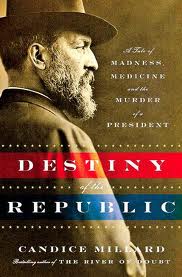
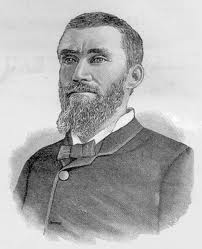
Borrowing the closing line from King Kong and morphing it a little “Oh no, it wasn’t Giteau that killed Garfield, it was the doctors!”, makes it fit Book Number 3 of 2013 Destiny of the Repbulic: A Tale of Madness, Medicine and the Murder of a President by Candice Millard. The subject of the book is the assassination of the 20th President of the United States, James A. Garfield. Considering the mass of information that most history classes cover about all you ever hear is that Garfield was shot by a disgruntled person who wanted a civil service appointment. What we weren’t told was the appointment Charles Giteau wanted was Ambassador to France, or what an amazing man and beloved President, Garfield was,if only for a short period. The tale of the assassination involves obviously Garfield, and Charles Giteau his assailant, but also includes the theories of Joseph Lister and the inventions of Alexander Graham Bell! Millard has taken these pieces and woven a fine and easy reading and enjoyable book!

A little about the characters. First James A Garfield. Garfield was born into extreme poverty his father was killed when he was to and his family was left with nothing, but through hard work and education Garfield rose to become a graduate of Williams College, a Union General and eventuallly the Republican nominee for President, When on the 34th ballot at the Republican Convention, Garfield’s name was placed in nomination Garfield’s reply was ” I challenge the correctness of the announcement. The announcement contains votes for me. No man has a right, without the consent of the person voted for, to announce that persons name and vote for him, in this convention,. Such consent I have not given….”. The chair refused his objection and eventually Garfield became the nominee. Garfield was a staunch abolitionist and his election was the first time blacks and whites voted along side each other to elect a President. In many ways his election reminded me of Obama’s because of what it meant to African-Americans!

Charles Giteau was insane no question about it his mission in life was to remove the President and save the nation and in the process, he would be loved by the new President Chester Arhtur and Sherman would march to the jail to free him! Giteau was known around the White House and visited often and at one point he even met the President! He stalked him for days before finally deciding on the train station for the execution. He never believed that he was doing anything wrong just removing the President much as if he died of natural causes!!

But the real kicker is that if it wasn’t for the treatment he received after the shooting lead by Dr Willard Bliss, he probably would have survived. Millard comments that if he were a derelict shoot in the Bowery of New York he would have survived. One of the main reasons for this is that the American Doctors did not believe in the antiseptic theories of Joseph Lister! Even  though death related to infections were dropping rapidly throughout Europe where Lister’s methods were employed!! The US doctors still wouldn’t believe, so they probe the wounds with fingers and unsterilized instruments and eventually Garfield rotted from within!

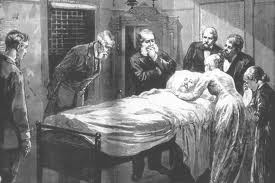
National Museum of Health and Medicine, Armed Forces Institute of Pathology, Washington, DC.
For 11 weeks Garfield endured unsterilized probings, large doses of quinine and a vermin-infested sickroom.

Finally, Alexander Graham Bell was thrust into the story as he rushed feverishly to create an induction machine that would find the bullet! He may have succeeded but Bliss was convinced that the bullet lay on the right side of Garfield’s body and would only allow Bell to search that side of Garfield’s body!

In this book that I think is the key to loving history she focused on the people that made the history and made the time period come alive with her descriptions of the cast of characters that surrounded the assassination!

NY Times Review: The Doctors Who Killed a President

A Happiness Project Update and Books 28 and 29 of 2012

Month One of My Happiness Project: Lessons Learned

So here’s the thing — after my first month of this happiness project, I’ve discovered I am terrible at keeping up with a daily resolution chart. Big, colorful tracker? Totally neglected.

But that doesn’t mean I haven’t been working on my resolutions. Over the last 20 days I’ve:

  • Exercised regularly – running three times a week
  • Tweaked my eating habits – whole wheat bagels with cream cheese for breakfast, walnuts back on my cereal, even switched to natural waffles
  • Cleared and reorganized – tossed and stored things I no longer need, including some paperback books I’ll never read (gasp!). I even moved a bookshelf so those “someday” books aren’t staring me down every day. Turns out constant guilt doesn’t make me happy.

I’ve also tackled some long-overdue tasks, like bringing home the last of my mom’s things from the care home.

The one thing I haven’t done so well? Going to bed earlier. But I have been more energetic — and acting like it — so I’m counting that as a win.


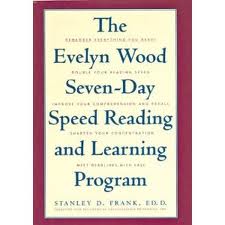
Book 28: The Evelyn Wood Seven-Day Speed Reading and Learning Program — Stanley D. Frank

The Evelyn Wood Seven-Day Speed Reading and Learning Program

I found this in the 75% off bin at Barnes & Noble for $1.86 — which made me happy before I even opened it.

The theory: reading faster could help me get to some of those relocated bookshelf titles. The book leans heavily toward study skills and would be most useful if I were still in school, but the speed reading tips are solid. With practice, I think I can boost my reading speed. Whether I’ll ever hit the 800–900 wpm range? Probably not. But I’ll be happy trying.


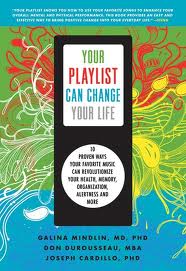
Book 29: Your Playlist Can Change Your Life — Galina Mindlin, Don Durousseau & Joseph Cardillo

Your Playlist Can Change Your Life

According to the authors, the right music can boost memory, organization, alertness, mood, and more. Using some of their ideas, I’ve already built a few playlists:

  • Calm Me Down – R. Carlos Nakai, Gary Burton, plus a little contemplative folk
  • Pick Me Up – Greensky Bluegrass, Ten Years After, Faces
  • Memory Boost – Songs with deep personal connections:
    • Bridge Over Troubled Water – Simon & Garfunkel (our wedding)
    • Morning Has Broken – Cat Stevens (our wedding)
    • The Stranger Song – Leonard Cohen (our first date)
    • Elvira – Oak Ridge Boys (our oldest son dancing as a little boy)

It’s a library book, but between the ideas and the results so far, I’m tempted to grab a copy with my Amazon birthday money.


Takeaway: If you’re stuck in a rut, try building a playlist around a mood or memory. It’s a quick, inexpensive happiness boost — and you might just dance in the kitchen.

My Playlists from Your Playlist Can Change Your Life

  • Calm Me Down – R. Carlos Nakai, Gary Burton, plus a little contemplative folk
  • Pick Me Up – Greensky Bluegrass, Ten Years After, Faces
  • Memory Boost – Songs with deep personal connections:
    • Bridge Over Troubled Water – Simon & Garfunkel (our wedding)
    • Morning Has Broken – Cat Stevens (our wedding)
    • The Stranger Song – Leonard Cohen (our first date)
    • Elvira – Oak Ridge Boys (our oldest son dancing as a little boy)

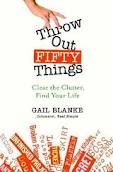
Book 27 of 2012 – Throw Out Fifty Things:Clear the Clutter Find Your Life!

So after reading The Happiness Project by Gretchen Rubin, I’ve started my own happiness project. I started at the beginning of this month, and started where Gretchen started, with Energy and Vitality. As part of the project, you create a series of resolutions to work on each month, and keep track of whether or not you have kept those resolutions on a daily basis, by making either an X for no, or a check for yes on a chart. While I am not doing well at keeping the chart, I have been working on the resolutions a little every day!

Gretchen points out in her book, that one of the biggest drains on energy is clutter, so one of her first resolutions was to Toss, Restore and Organize. I have been doing fairly well with this resolution and I’ve tossed quite a few things! Additionally, I read Gail Blanke’s book Throw Out Fifty Things: Clear the Clutter, Find your Life , which is Book 27 for 2012! The book is a great read and provides a usable framework for clearing the physical clutter from both your home and office, as well as, the mental mess!  The last part of the book addresses what you do after you’ve cleared away all that clutter and CAN finally see your life!!

There were a several chapters in Part Three of the book, Attacking the Mental Mess that really struck home like: Chapter 11 Letting of Feeling Inadequate, Irrelevant and Just Plain Not good Enough, Chapter 13 Letting Go of Regrets and Mistakes of the Past, and particularly Chapter 16 Letting Go of Thinking the Worst!  It’s nice to know  that other people suffer from Thinking the Worst. I made myself crazy worrying about a projet this winter and early spring – irrationally fearing the worst only to have everything work out ok!! Got to let it go!

Now while I’m finished reading the book, I am not finished with the book. I’ve got 21 more days in October to work on my resolutions and part of that time will be spent using the workbook I found at Throwoutfiftythings.com, and I know I’m going to throw out way more than fifty things!!! Here’s Gail talking about throwing out fifty things!!


Find more videos like this on Throw Out Fifty Things

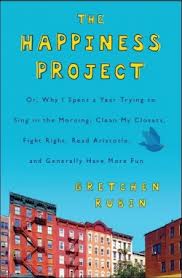
Book 25 of 2012 – The Happiness Project – Gretchen Rubin

One day while riding on a bus Gretchen Rubin realized that her life was passing her by and while she was happy, she wasn’t as happy  she could be,  so she decided to dedicate a year to trying to be happier.  Book 25 of 2012 The Happiness Project or Why I Spent a Year Trying to Sing in the Morning, Clean My Closers,Fight Right,Read Aristotle, and Generally Have More Fun chronicles that year of discovery and provides a blueprint for readers to start their own happiness project!

The Happiness Project consisted of focusing each month on an aspect of her life, then making resolutions about that aspect, followed by grading how well she did each day keeping those resolutions! As an example in January her goal was to boost her energy, knowing that when she felt more energetic it was easier to be happy! Her resolutions included: Go to sleep earlier, Exercise better, Toss, store and organize, Tackle a nagging task and Act more energetic. Then using the works of various authors on happiness she explores happiness and  how to pursue it, as she tackles each resolution! In March the goal was to Aim Higher-Work and one resolution was to Launch a Blog and The Happiness Project was born!

The First Splendid Truth, which she discovered in the second month of her voyage into happiness was: To be happy, I need to think about feeling good, felling bad, feeling right, in an atmosphere of growth.  To me this sums it all up. First, you have to concentrate on those things that you do or use to do that make you happy and strengthen them, then you need to focus on eliminating your actions that make you feel bad (like procrastination, nagging, etc). Next you need to be feeling right by doing things that are aligned with your core values. Feeling right is about living the life that is right for you, in occupation, location, marital status and so  on.   Finally, you need to be putting everything together “in an atmosphere of growth”. Here she uses a quote from Yeats “Happiness is neither virtue nor pleasure nor this thing nor that but simply growth. We are happy when we are growing”  She points out “Contemporary researchers make the same argument that it isn’t goal attainment but the process of striving after goals that is, growth – that brings happiness.”

I certainly understand this argument, I’ve worked at the same job for thirty years but through most of that time I was growing and learning. First I needed to learn as much as I could about soil as I could, to design septic systems.Later to delineate wetlands, I needed to know more about hydric soil coupled with vegetation identification i.e tree, shrub and herbaceous plants. Along the way, I also needed to know the geology and hydrology of New Jersey, AutoCad and all the environmental laws and regulations that govern development in New Jersey! So while I was working at the same place I was always doing something a little different,hence, I was always  growing and not unhappy!

The main reason that I picked up the book was that while I am not unhappy, I do feel that I could be happier and after reading the book, I know I can be happier and I now have a blueprint to follow to help me get there! Now I only have to make myself do it!!  Anyone want to join me?  Check out the book and see if it’s “feels right” for you! It does for me!


Book 8 of 2012 – A Secret Life: The Lies and Scandals of President Grover Cleveland


Imagine a presidential candidate is accused of fathering a child out of wedlock! Oh, yeah, we had that with John Edwards and Rielle Hunter. Only this candidate admitted paternity, the child was named after his best friend and he still was elected the 22nd president of the United States! The story of this scandal and others form the foundation of Book 8 of 2012, Charles Lachman’s  A Secret Life: The Lies and Scandals of President Grover Cleveland. The book claims to reveal for the first time the true story of Maria Halpin the young woman, who according to the book was raped by the future president, give birth to a son,  had her baby taken away from her and  finally was thrown in an insane asylum when she tried to get the child back. While the book may be a little short on proof on all that went on it is still a fascinating read. It is easy reading and provided a look into the politics of 1880’s, as Cleveland rose for a one term sheriff of Buffalo, to governor of New York, and then candidate for President. He was even supported by several staunch Republicans!  Needless to say, I don’t think he’d have a chance of getting elected in today’s political arena!!

For me one of the most interesting aspects of the book was the acceptance of the

English: Portrait drawing of First Lady of the...

Image via Wikipedia

forty-nine year old Cleveland’s marriage to 22 year old Frances Folsom, the daughter of his late best friend Oscar Folsom. Cleveland had known and doted on Frances from the time she was a little girl, climbed on his knee, and called him “Uncle Cleve”!!

The book also touches on his sister Rose’s time serving as First Lady prior to Clevelands marriage and her secret sex life. As well as, Cleveland’s secret cancer operation.

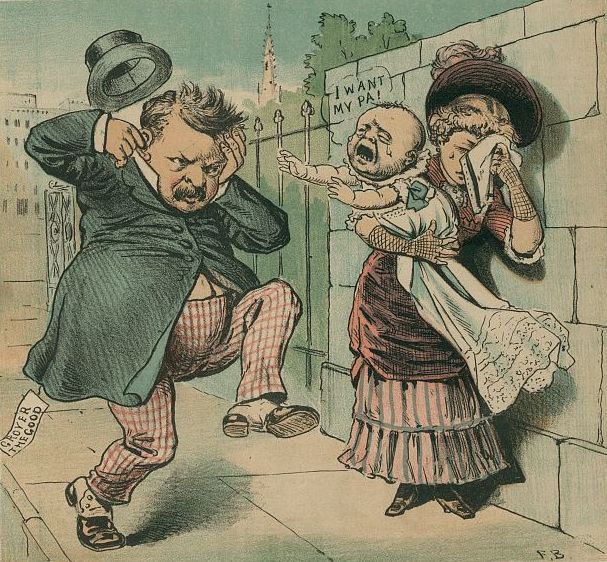
So if you enjoy history, a little on the light side, then this is a book for you. Through out the 1884 campaign, the cry was “Ma. Ma, Where’s my pa!” , when Cleveland won the phrase was turned into “Ma Ma Where’s my Pa, went to the White House, ha,ha,ha!”. I don’t think that would happen today!

Enhanced by Zemanta

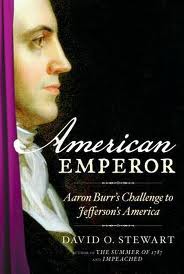
Book 5 of 2012 – American Emperor – David O. Stewart

So most tines when I read non-fiction I start out well, then get bogged down and end up only reading a third to half of the book. Well, I decided to stick with Book 5 for 2012 American Emperor:Aaron Burr’s Challenge to Jefferson’s America by David O. Stewart and I finally finished it tonight! I renewed the book from the library about three times! The book follows Burr’s life basically from the duel with Alexander Hamilton through to his death and focuses mainly on Burr’s plans to conquer the Spanish possessions in Florida and then invade Mexico and set himself up as Emperor. The book was a little slow in parts but overall it was well written. While I have read before about Burr’s treachery and his association with that weasel General James Wilkinson (see another non-fiction book setting on my shelf An Artist in Treason about Wilkinson which I have stopped about a third of the way through) I had not read much about Burr’s trial for treason which I found very interesting. A couple of other parts of the book that I found interesting included a discussion of the Louisiana Purchase most times I just think, oh Jefferson bought this area in 1803 and never think about the assimilation of the people  who lived there into the US! It was hard for the Creoles to adjust. The other was the time it took to get from place to place. The description of Burr’s return trip to Washington from New Orleans in 1805 took from July to November and the description of having to almost cut your way through the forest as you traveled made me realize what an ordeal it was to travel! It took Wilkinson three months to get from New Orleans to Washington for Burr’s Treason trial!

All in all it was a good read and recommended for anyone who likes reading about the history of that time period!

Here’s a video of Stewart talking about the book

Book 4 – The Big Con or maybe Book 3 of 2012

So I finished book 4 for 2012 The Big Con: Crackpot Economics and the Fleecing of America by one of the senior editors of the New Republic Jonathan Chait. Oh wait that’s Book 4 what about Book 3 I forgot to write about it! What was it oh yeah, Moonwalking with Einstein: The Art and Science of Remembering Everything  by Joshua Foer. Guess I learned a lot, huh! Anyway that book was really good and did have some great ideas for remembering things. Joshua Foer became intrigued by the National Memory Championship and interviewed some of the participants trying to find out what made these people so adept at remembering. What he found out is that they are just like everyone else but they know the tricks of how to remember. From there Foer enters the world of the memory experts and trains to compete. The book follows his journey as he uncovers the secrets that date back to early Greek and Roman times, discuss folks with great memories like S, and some that can’t remember at all and through his journey he discover that a big part of being human is remembering! It amazes me that the world record for memorizing a deck of cards is around 37 seconds! But the tricks of the trade are interesting and some of them are useful for remembering things other than PI to a gazillion digits!

One of the main methods that is used to remember is to convert what you want to remember and then store it in a location in a building, or on a street that you know well. The buildings are called Memory Palaces and the competitors have many that they use. The point is when you need to remember you take a walk back through the Memory Palace and pick up the items you dropped!!

Anyway I was a good read and hopefully some of the tricks will be remembered and can prove useful! Cause like Tom Rush laments as we get older we tend not to remember quite as well! More about Book 4 later!


Enhanced by Zemanta

Book 36 of 2011 – The Wrecking Crew – Thomas Frank

Mother Jones: Kevin Drum: Republicans Don’t Care About the Deficit

As Drum and Krugman point out the Republicans don’t care squat about the deficit and why should they they created most of it and since it makes government look bad  and they hate government why is it a bad thing!

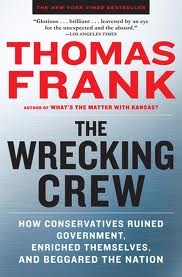
Book 36 for the year was Thomas Frank’s The Wrecking Crew: How Conservative Ruined Government, Enriched Themselves and Beggered the Nation kinda sum it all up doesn’t it!!The book does sum it all up and tells the tale of how the Republicans have destroyed our functioning government. It’s quotes like these that caught my eyes over the last few chapters:

the main reason that conservative administrations immediately run up as large a deficit as possible is that it defunds the left

or

with their beloved government brought to the brink of fiscal collapse by repeated doses of supply side, the liberals would either have to acquiesce in the reconfiguration of the state or see the country destroyed.

from David Stockman and the Reagen administration: Deficits were a way to smash a liberal state that voters could not be persuaded to part with otherwise

from Robert Reich: “If the public thinks government is wasteful, that’s fine. That reduces public faith in government which is precisely what the Republicans want”

It’s a win-win for the Republicans!

from Louis Brandeis (Supreme Court justice 1916-1939)

“We can have democracy in this country or we can have concentrated wealth in the hands of a few, but we can’t have both”

So if you want a good primer on the Republican’s tactics for bringing down the government read this book!

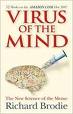
Book 7 – Virus of the Mind – Richard Brodie

So I want all the folks who graduated high school and college prior to 1977 who know what a meme is to raise their hands! Did lots of hands go up! If they did then you’re better than me.

Until I read Richard Dawkins The God Delusion I did not know about memes. But now after reading that book and Book Number for 2011 Virus of the Mind by Richard Brodie I know a little more about this basic unit of cultural transmission and imitiation and memetics which is the study of the working of memes, how they interact, replicate and evolve

. A meme (rhymes with cream) is an idea that forms itself into a distinct memorable unit and then is spread through a culture. They are the cultural equivalent of the gene. The term was coined by Richard Dawkins in his book The Selfish Gene. Memes can exist concerning any thing in life like danger, fear, sex and religion. Those that are best at replicating themselves keep evolving while others don’t far as well and are replaced.

An example would be the Roman and Greek Gods for many years their memes were strong and dominated the culture but when science explained things they lost their ability to replicate and soon faded. Likewise religions like Mithra-ism a and other pagan religions flourished and died, while the memes of Christianity and Islam continued to replicate and be spread.

Memes can include anything like “Things go better with Coke” or other advertising slogans that have infected us and are spred throufhout the cultural. Memes do not have to be necessarily good for you, just good at replicating themselves!

The book was a good start at looking at memes and I want to explore the subject in more depth, possibly in books like The Meme Machine by Susan Blackmore. Richard Brodie writes well for the common man and I just picked up his first book Getting Beyond OK at the library today.

Brodie wrote the original version of Microsoft Word during his years at Microsoft. Now I have to get cracking on some mysteries as the non-fiction has surpassed the fiction for the first time in a long, long time.